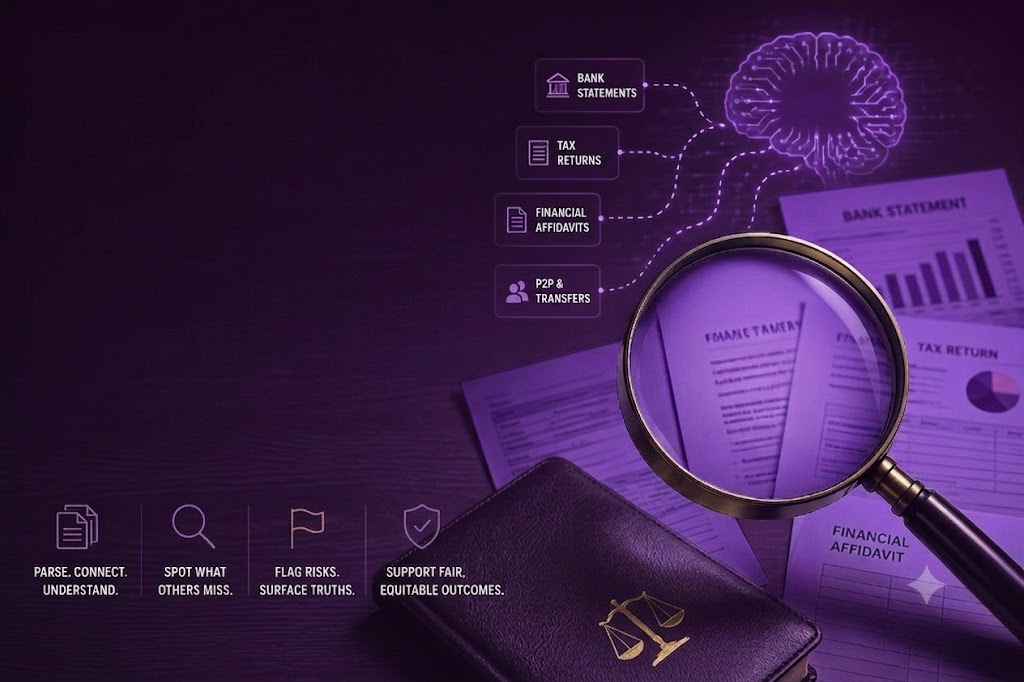
AI and Divorce Finances:
How to Find
What's Hidden
How AI reads years of financial records, connects the dots, and flags hidden assets and dissipation so nothing important gets overlooked.
- Parse. Connect. Understand.
- Analyze. Spot what others miss.
- Flag. Surface risks. Surface truths.
- Prove. Support fair, equitable outcomes.
Money is the part of divorce most people fear. You worry the full picture is not on the table. You worry a forensic accountant costs more than the assets you are fighting over. You worry the paperwork will bury you before you ever find the truth.
Those fears are reasonable. About a quarter of divorced people admit they hid assets from their former partner, and roughly 40% of spouses have committed some form of financial deception. Yet most people walk into a divorce without the tools to check. Forensic accountants bill $300 to $600 an hour, and a full engagement runs $15,000 to $60,000 in business-owner and high-asset cases. So three out of four family law litigants now represent themselves, mostly because they cannot pay for the help they need.
This is the exact problem AI was built for. Not the science-fiction version. The practical version: reading a mountain of unstructured records, organizing it, and pointing a human toward the few transactions worth a second look. Below is a plain-language guide to how it works, what it catches, and where it stops.
Why divorce is the hardest data problem in law
Corporate contracts follow templates. Divorce records do not. A single case pulls together thousands of pages of bank statements, credit card statements, tax returns, retirement accounts, and business ledgers. Layered on top are sworn financial affidavits, Venmo and Cash App histories, loan agreements, and court orders that change month to month.
The data arrives incomplete, contradictory, and emotionally loaded. A spouse swears one income in an affidavit while the deposits tell a different story. A business expense for a Miami trip sits next to a personal card payment for the same week. The work is stitching a coherent financial narrative out of conflict and chaos, and humans are slow at it precisely because the volume is crushing.
AI is good at the opposite thing. It does not get tired on page 400. It reads every line, holds the whole record in view at once, and looks for relationships across documents that no single page reveals on its own.
How AI actually works on divorce finances
The phrase "AI finds hidden assets" hides the real mechanics. AI does not open a vault. It connects dots. Understanding how it does this tells you what to trust and what to verify.
The work happens in four stages. First, a model reads each document and extracts structured data from messy formats: every transaction, date, amount, account, and sworn figure. Second, it tags ownership, so a deposit is linked to the right spouse, account, and business. Third, it cross-references the records against each other, matching a claim in one document to evidence in another. Fourth, it flags the gaps where the story does not line up.
Stage three is where the real value sits, and it is worth slowing down on. A financial affidavit is a set of claims. A bank statement is a set of facts. On their own, neither proves much. Side by side, they tell you whether the claims hold. When a spouse swears an income that the deposits contradict, the gap is a lead. When a court orders a payment and no matching debit appears in the due window, the gap is a lead. AI is built to find those gaps at scale, across years of records, in the time it takes to make coffee.
This is what "connecting the dots" means in practiceThrive Financial calls this its Case Intelligence Layer. When you parse a legal filing, it pulls out every assertion, obligation, and key date. A reconciliation engine then tests each one against your transactions and tax returns. An income claim is checked against bank deposits for that year. A claim of insolvency is checked against business activity after the claim date. The result is a list of questions backed by evidence, not a hunch.
What AI catches that a tired human misses
Most hidden money is not in an offshore account. It is hiding in plain sight, spread across normal-looking transactions. Here are the patterns AI is trained to surface.
- The business expense black hole. Personal vacations and dinners booked as business costs. AI cross-references business and personal accounts to find the overlap between what the company paid for and who actually benefited.
- The P2P shuffle. Vague Venmo, Zelle, and Cash App notes like "stuff" or "lunch" can move thousands to a friend or a new partner. AI reads payment histories for frequency and patterns instead of trusting the labels.
- The friendly loan. Money "lent" to a sibling right before filing, returned after the decree. AI anchors transfers to dates, so a loan that lines up with the filing timeline gets flagged.
- Undervalued assets. A business, stock options, or a collection listed far below its worth. AI compares the value sworn in an affidavit against figures in tax returns and statements.
- Post-separation dissipation. Sudden spending spikes and large cash withdrawals after the split. AI sets a threshold from the case's own history and marks the outliers.
This is also where financial control and coercion leave fingerprints. A spouse who hid the accounts during the marriage often kept moving money during the separation. A timeline that anchors transfers to the separation date turns a vague feeling of "something is off" into specific, dated questions for counsel.
The claim that does not match the evidence
The single most useful thing AI does in a divorce is compare what someone swore to against what the records show. Lawyers call the difference disclosure variance. It is the engine of most contested financial cases.
The number on the right is not proof of fraud. A deposit could be a one-time gift, a loan, or a transfer between the spouse's own accounts. A good system says so and tests the innocent explanations first. What AI gives you is the starting point: here is the gap, here are the transactions behind it, go verify them against the source documents. That is a lead a person can act on, produced in minutes instead of billable weeks.
Closing the access-to-justice gap
The reason this matters beyond efficiency is cost. When three quarters of family law litigants cannot afford representation, the financial truth becomes a luxury good. The person with the resources to hire a forensic accountant has leverage. The person without them takes the disclosure on faith.
AI changes the math. A first-pass review that once required a retainer now costs a fraction of one. People who could never afford a full forensic engagement get a structured, defensible look at their own case. When the AI surfaces something serious, that evidence helps justify the expense of a human expert. When it finds nothing, you have bought peace of mind cheaply. Either way, the floor of quality rises for everyone.
What AI does for each role
The same engine serves four very different users, because each one needs the same facts organized a different way.
Individuals and pro se filers
Plain-language clarity on your own finances. Prepare smart questions for a lawyer or mediator, and walk in knowing the numbers instead of guessing at them.
Family law attorneys
Cut the non-billable hours your team spends typing transactions into spreadsheets. Move from "he said, she said" to "the records say," with deadlines and findings in one place.
Forensic accountants and CDFAs
Use AI as a first-pass triage tool. Let it handle the data prep and flag the anomalies, so your expert hours go to deep analysis and testimony.
Divorce coaches
Give clients clear, visual financial summaries they understand. Turn overwhelm into a checklist and a set of next steps.
Where AI stops, and why that matters
Honest is more useful than impressive. AI in divorce finance has hard limits, and a tool worth trusting names them.
AI findings are leads, not verdicts. A flag is a prompt to review the original document, never a conclusion of fraud. The output supports how evidence gets presented, but admissibility is still governed by the rules of evidence, authentication standards, and your attorney's strategy. A tool that promises guaranteed court admissibility or automatic proof of hidden assets is overselling, and a judge will notice.
What makes a finding defensible is provenance. The strongest setup preserves the original file exactly as uploaded, records a cryptographic hash so any later change is detectable, keeps a timestamped log of every action, and keeps the source document one click away from the finding that cites it. Thrive Financial builds this in: every case export is sealed with a SHA-256 hash, original files are stored beside their parsed data, and a certificate of authenticity ties the two together. The point is not that AI is right. The point is that you can always check.
| What AI does well | What stays human |
|---|---|
| Read years of records in minutes | Decide what the findings mean for strategy |
| Match sworn claims to evidence | Verify each flag against the source |
| Flag anomalies and timing patterns | Establish intent and legal admissibility |
| Organize exhibits and timelines | Advise the client and argue the case |
See your finances the way the evidence does
Thrive Financial reads your statements, tax returns, and affidavits, connects the related records, and flags what deserves a second look. Your data stays on your device. Start free, no credit card required.
Start your free caseFrequently asked questions
Can AI find hidden assets in a divorce?
AI cannot prove fraud on its own, but it reads years of bank statements, tax returns, and P2P histories in minutes and flags patterns a person would need weeks to spot. It surfaces leads, such as transfers before filing or income that does not match a sworn affidavit, which a human then verifies against the original records. Learn more in our resource library.
How much does a forensic accountant cost in a divorce?
Forensic accountants charge roughly $300 to $600 per hour, and full divorce engagements often run $15,000 to $60,000 in high-asset or business-owner cases. An AI-assisted first pass costs a fraction of that and helps you decide whether a paid expert is worth retaining. See our pricing for how a first look compares.
Is AI divorce financial analysis legally defensible?
Defensibility depends on provenance, not on the AI itself. Strong tools preserve the original file, record a cryptographic hash, log every action, and keep source documents one click away so findings can be verified. The output supports evidentiary presentation, but admissibility is still governed by the rules of evidence and your attorney's strategy.
What is dissipation of assets?
Dissipation is the use of marital money for a purpose unrelated to the marriage, often with intent to deprive the other spouse of their share. Common signs include sudden spending spikes, large unexplained cash withdrawals, and loans to friends that are never repaid, especially after separation. Thrive Financial's Asset Tracer flags these patterns across years of records.
Further reading and helpful resources
These independent resources go deeper on the topics above. None of them is affiliated with Thrive Financial.
- American Bar Association: Why Family Law Needs AI More Than Any Other Practice Area. The case for AI in family law, from the profession's own publication.
- Justia: Hidden Assets and Your Legal Rights in Divorce. Warning signs, the discovery process, and what courts do when a spouse conceals property.
- LawHelp.org. Free and low-cost legal aid by state for people who cannot afford a lawyer.
- IRS: Get Your Tax Record. Request official tax transcripts, a core document in any divorce financial disclosure.
- FTC Safeguards Rule. The federal standard for how financial information must be protected, worth knowing before you upload records anywhere.
Thrive Financial is a financial-analysis and case-organization tool, not a law firm, accounting firm, or substitute for licensed professional review. AI outputs are leads for review and should be checked against the original source documents and, where appropriate, by a licensed attorney or financial professional. Sources: American Bar Association, "Why Family Law Needs AI More Than Any Other Legal Practice Area" (2026). Investec Wealth & Investment hidden-assets study. National Endowment for Financial Education financial-deception survey. Published forensic accounting fee guides (2025).
Continue Your Investigation
Use these guides to keep moving from issue spotting into document review, security, and evidence building.